About Adaptive Grids for Modeling Space Weather (Flash Games)
Adaptive Grids for Modeling Space Weather is a classic release for Flash Games. Playable directly in your web browser without third-party plugins, this title runs at a locked 60 frames per second using client-side WebAssembly.
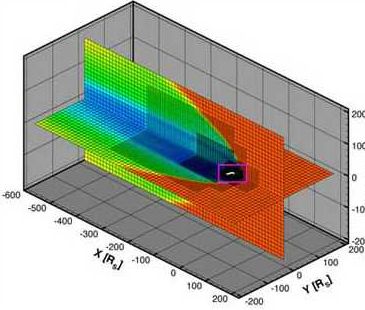
Scientists use computer models to study complicated things. Sometimes the things scientists study are so complicated that it takes many days for the computers to run a model... even on a powerful supercomputer. Scientists are always trying to figure out ways to make their models run faster. On way of doing that is using something called an "adaptive grid". Models represent space with a bunch of grid cells. The grid cells are sort of like the small squares on a piece of graph paper. If the model has lots of grid cells, it can do a better job of telling us what the real world is like. If it has fewer grid cells, it won't be quite as accurate. However, a model with lots of grid cells can take a long time to run. The computer has to make calculations for each grid cell, and sometimes models have thousands or even millions of cells. Even a supercomputer might take months to run a model like that. Models with fewer grid cells run faster and get done sooner, but are not as accurate. Scientists have to choose between a model that runs faster or a model that is more accurate. Of course, scientist would like models that run fast and are accurate. One way they can make models like that is by using an adaptive grid. What is an "adaptive grid"? An adaptive grid uses lots of small grid cells in some parts of the model, and fewer big grid cells in other parts. Usually it is important for the model to be very accurate in certain places. There are other places, though, where the model doesn't need to be quite as accurate. The adaptive grid uses lots of small grid cells in places where it needs to be most accurate. That makes the computer have to work hard. The adaptive grid uses fewer, large grid cells in other places where it doesn't need to be as accurate. That gives the computer a break, so it can run the model faster. The interactive above shows an adaptive grid. These pictures are from a space weather model. It shows radiation and magnetic fields moving out from the Sun to Earth. Can you see the grid cells in these views? Notice how the grid cells have different sizes. In this model, it is important to really know what is going on near the Sun and close to Earth. Those are the places where there are lots of little grid cells. It isn't so important to know what is going on in all of space between the Sun and Earth, so most of those grid cells are bigger. In this space weather model, the Sun is the light gray sphere on the right in the 6 Rs and 1.5 Rs views. Earth is a tiny gray dot near the middle of the 0.19 Rs view and a larger gray sphere in the 0.05 Rs view.
Active Controller & Keyboard Bindings
Your custom bindings are saved automatically per console and work immediately inside the emulator.
| Console Input | Keyboard Key | Gamepad Button | In-Game Action | Edit |
|---|